Transformation takes place in a series of steps. Essentially genetic recombination in bacteria refers to a process through which a.

Induced Fit Model Of Enzyme Action Enzymes Active Site Chemical Changes
The bacteriophages only infect a single species of.

. They were discovered by F. Phage therapy works because bacteriophages kill bacteria by making them lyse or burst. The use of bacteriophages played a prominent role in elucidating.
During the lytic cycle of viral replication the virus hijacks the host cell degrades the host chromosome and makes more viral genomes. In the lytic cycle the phage injects its DNA into the host bacterium after adsorbing on to the host surface. The added genetic information provided by the DNA of a prophage may enable a bacterium to possess new genetic traits.
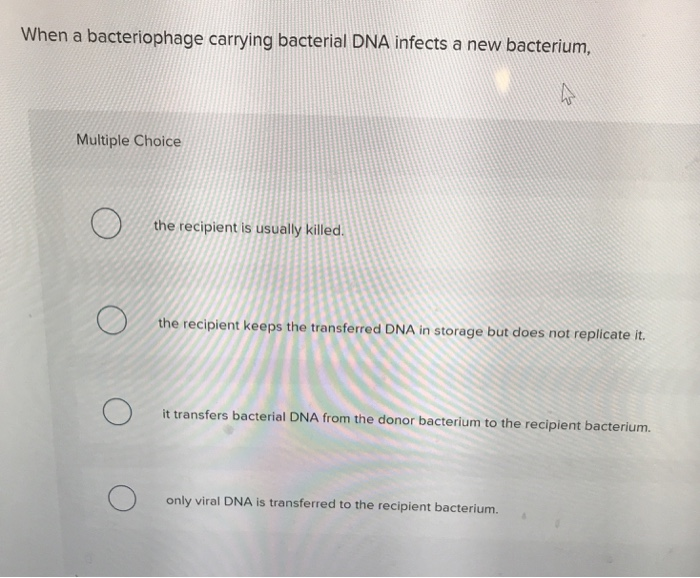
DISCOVERY AND INTRODUCTION Bacteriophages were discovered independently Twort 1915 in the UK and Hérelle 1917 in France and the term was coined by Hérelle. When a bacteriophage carrying bacterial DNA infects a new bacterium Multiple Choice the recipient is usually killed. Generalized and specialized transduction.
This induces the shift of the host bacteriums protein machinery to replicate phage DNA and develop 50-200 new infectious phages. Some bacteria become virulent only when infected themselves with a. 1 Binding of foreign DNA to the surface of the competent bacterial cells.
It does so by injecting genetic material either DNA or RNA which it carries enclosed in an outer protein capsid. The recipient keeps the transferred DNA in storage but does not replicate it. There are two types of transduction.
The recipient keeps the transferred DNA in storage but does not replicate it. In specialized transduction it is thought that lysogenic phages which have been amplified in a population of bacteria excise some bacterial DNA with their genome when. Sometimes that DNA integrates into the new bacteriums genome.
Bacteria have receptor sites on their surfaces 2 Penetration of the foreign DNA facilitated by proteins in the cell membrane which allow specific plasmids or DNA sequences to penetrate 3 Synapsis of the foreign DNA and bacterial DNA locus to locus 4. The vast majority of. O o oo it transfers bacterial DNA from the donor bacterium to the recipient bacterium.
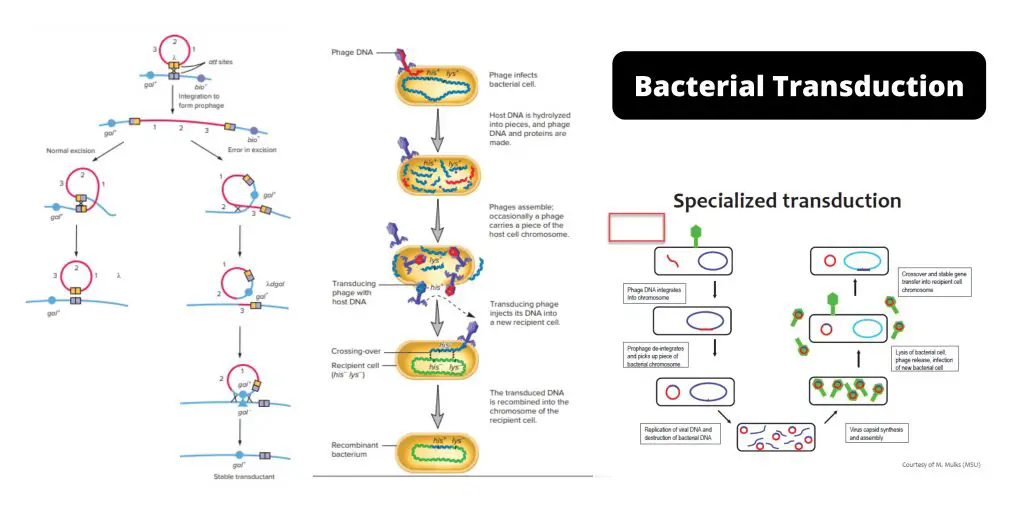
Transduction in bacterial cells is a type of genetic recombination in which a piece of chromosomal DNA is transported from one bacterial cell referred to as the donor to another bacterial cell the recipient by a bacteriophage the bacterial virus that is also known as a phage. A bacteriophage is essentially a virus consisting of DNA or RNA that is enclosed within a protein shell. The lysogenic cells may exhibit new properties such as toxin production eg scarlet fever diphtheria or.
A bacteriophage is a type of virus that infects bacteria. When a bacteriophage carrying bacterial DNA infects a new bacterium 1. This process is known as adsorption.
To enter a host cell bacteriophages attach to specific receptors on the surface of bacteria including lipopolysaccharides teichoic acids proteins or even flagella. Here we will have a closer look at the topic its. Some bacteriophages like the T4 bacteriophage that infects Ecoli also have a protein tail composed of fibers that help attach the virus to its host.
Such a virus infects the cell of bacteria and carries out reproduction inside it. Thus all bacterial daughter cells carry a copy of the prophage DNA and are referred to as lysogenic bacteria. During the lytic cycle of viral replication the virus hijacks the host cell degrades the host chromosome and makes more viral genomes.
Viruses contain genetic material in the form of DNA or RNA but not both. Only viral DNA is transferred to the recipient bacterium. This process is known as transduction.
When the phage delivers the donor bacterial DNA to the recipient bacterium the recipient can integrate the DNA into its own chromosome. They can differ in their shapes and genetic material. Phages are bacterial viruses and are thought to be the most abundant and diverse biological entities on Earth.
There are two types of transduction. This cycle takes place in the following steps. Lytic bacteriophages usually cause the host bacterium to lyse.
Transduction can also occur as part of a lysogenic life cycle. The recipient is usually killed. It transfers bacterial DNA from the donor bacterium to the recipient bacterium.
As a result the host become weak and eventually ruptures to release the new phage particles. In the Lytic Cycle a bacteriophage infects a bacteria and kills it to release progeny virus. Transduction occurs when a bacteriophage transfers bacterial DNA from one bacterium to another during sequential infections.
This phage tail binds to the host receptor sites Haq et al. Generalized and specialized transduction. Only viral DNA transfenred the recipient bacterium.
Bacteriophages occasionally remove a portion of their host cells bacterial DNA during the infection process and then transfer this DNA into the genome of new host cells. The bacteriophage then reproduces and replicates itself inside the bacteria. Should the phage carrying this bacterial DNA inject it into a healthy host cell it may integrate into the chromosome of that bacterium altering its genome and that of its daughter cells.
Bacteriophage or Phage is a virus that infects and replicates only within the body of bacteria and no other organism. When a bacteriophage carrying bacterial DNA infects a new bacterium Multiple Choice the recipient is usually killed_ the recipient keeps the transferred DNA in storage but does not replicate It it transfers bacterial DNA from the donor bacterium tO the recipient bacterium. Highly species-specific towards their host cell.
When a lysogenic phage genome integrated into a bacterial genome pops back out to replicate. The tips of the tail fibres attach to specific receptors on the surface of the bacterial cell. The protein shell or capsid protects the viral genome.
When the bacterial host DNA replicates the prophage DNA is replicated as well. Transduction occurs when a bacteriophage transfers bacterial DNA from one bacterium to another during sequential infections. A bacteriophage attaches itself to a susceptible bacterium and infects the host cell.
They can have either single- or double-stranded RNA or DNA genomes and these are surrounded by a protein capsid connected to their phage tail. This can result in thousands of new bacteriophages in each bacterium. This occurs when the virus binds to the bacteria and infects it by injecting its genome DNA or RNA into the bacteria.
Sets with similar terms Types of Virus DNA vs RNA Enveloped vs. Bacteriophages or bacterial viruses are a type of viruses that infect bacteria. When a bacteriophage carrying bacterial DNA infects a new bacterium a the recipient is usually killed bthe recipient keeps the transferred DNA in storage but does not replicate it.
When the phage particle infects a new bacterium the packaged DNA from the original host bacterium is introduced into the new bacterium. The bacteriophage attaches itself on the surface of bacteria.
Solved When A Bacteriophage Carrying Bacterial Dna Infects A Chegg Com
Bacterial Transduction Generalized And Specialized Transduction
Microbe Trolls Transduction Transduction Is The Process By Which A Virus Transfers Genetic Material From One Bacterium To Another Viruses Called Bacteriophages Are Able To Infect Bacterial Cells And Use Them

Bacteriofagos Vistos Al Microscopio Y Coloreados Electron Microscope Microscopic Photography Science



0 Comments